AI Is Still a Tool: Why Understanding the History of Human Innovation Matters More Than the Fear

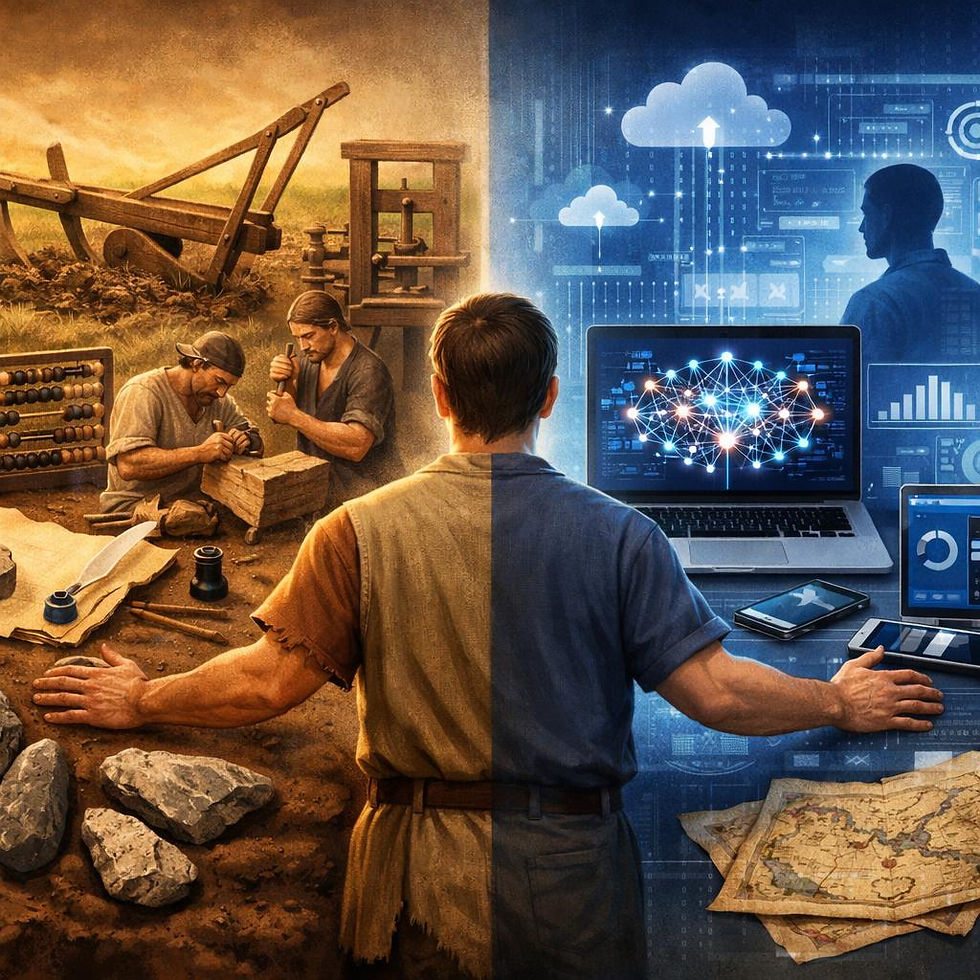
Artificial intelligence feels different to many people. Not because it is alive, not because it is conscious, but because it operates in a space we have long associated with thinking, writing, and decision-making. That closeness has created a sense of doom that is disproportionate to what the technology actually is.
History gives us perspective here.
Every major tool that reshaped human effort was first misunderstood. AI is not an exception to that pattern. It is the continuation of it.
Understanding this requires AI literacy, not in the sense of coding or engineering, but in the sense of orientation—knowing what a tool is, what it does, and where it stops.
A Plain-Language Definition of AI (Without the Hype)
Artificial intelligence, as it exists today, does not think, believe, intend, or understand.
At its core, AI:
Detects patterns in large amounts of data
Predicts likely outputs based on probability
Responds within constraints defined by humans
Requires infrastructure, prompts, and oversight to function
AI does not:
Possess awareness
Form goals independently
Understand truth or meaning
Replace human judgment
The reason AI feels intelligent is because language and prediction overlap closely with how humans communicate. That overlap creates an illusion of agency where none exists.
AI is not a mind.
It is a machine-assisted pattern tool.
Tools Have Always Pressured Humanity, Not Replaced It
The plow increased food production and reduced physical strain. Writing offloaded memory. The printing press scaled knowledge. Calculators moved arithmetic away from manual effort and toward conceptual thinking.
Each advance disrupted existing skill sets. Each produced fear that humans would become dependent, weaker, or less capable. None of those fears materialized as extinction of skill. Instead, skills shifted upward.
AI is doing the same thing for cognitive labor.
The mistake we keep making is tying human worth to the most recent form of effort.
Why Some Tools Disappear and Others Endure
Tools disappear when faster, more accurate methods exist without sacrificing meaning.
Ledgers gave way to spreadsheets. Typewriters gave way to word processors.
But tools like hammers, chisels, paintbrushes, instruments, and athletic equipment never leave. They demand:
Judgment
Tactile feedback
Craft
Presence
Manual application does not vanish in advanced societies.
It becomes intentional and valued.
Automation does not erase humanity. It clarifies what requires a human.
AI Compared to Traditional Tools (A Clear Contrast)
Tool | What It Reduced | What It Preserved |
Plow | Physical strain | Agricultural judgment |
Printing press | Copying effort | Interpretation |
Calculator | Manual arithmetic | Mathematical reasoning |
Search engine | Lookup time | Evaluation |
AI tools | Repetitive cognition | Judgment, values, accountability |
AI is closer to calculators than consciousness.
It changes effort, not agency.
Why AI Feels Like a Bigger Threat
AI does not amplify muscle.
It amplifies cognitive throughput.
That creates discomfort because modern identity is tied to:
Writing
Analysis
Expertise
Professional authority
AI exposes something many people are unprepared to face: much of what we labeled as “thinking” was procedural.
This is not an insult.
It is a recalibration.
What AI Replaces and What It Reveals
AI replaces:
Repetitive drafting
Baseline summarization
Mechanical analysis
Pattern recognition at scale
AI reveals:
Weak reasoning
Poor question framing
Lack of foundational understanding
Reliance on credentials instead of competence
The tool does not lower the bar.
It shows where the bar was already low.
What AI Should Never Be Allowed to Do
A critical piece of AI literacy is knowing where the line is.
AI should never:
Make final decisions affecting human welfare without oversight
Define values or ethics
Replace accountability in education, healthcare, or justice
Be used to obscure authorship or responsibility
Act as authority instead of assistance
Human judgment must remain explicit, not assumed.
Media, Fear, and Why Doom Spreads Faster Than Clarity
Fear spreads because it draws attention.
Movies, headlines, social platforms, and incentive structures reward apocalyptic framing. Nuance does not go viral. Responsibility does not trend.
Naming this matters. When fear is identified as amplification rather than inevitability, it loses power.
Misuse vs Responsible Use (A Concrete Example)
Misuse in education:A student submits AI-generated work without understanding, reflection, or authorship.
Result: Shallow learning and skill erosion.
Responsible use in education:A student uses AI to outline ideas, receive feedback, and revise with human judgment.
Result: Stronger writing, deeper understanding, retained responsibility.
Same tool. Different intent.
AI Literacy Is Orientation, Not Engineering
AI literacy means understanding:
What outputs represent
Why confidence is not accuracy
How data shapes responses
Where humans remain responsible
This applies to parents, educators, leaders, and learners alike.
Literacy is not about control.It is about discernment.
AI in Learning Technologies and Self-Development
In learning environments, AI can support:
Accessibility
Feedback
Personal pacing
Administrative relief
It must not replace:
Assessment integrity
Mentorship
Intellectual struggle
Value formation
In self-development, AI can assist planning and reflection, but it cannot supply discipline, purpose, or moral reasoning.
Tools assist growth.
Humans choose direction.
The Consistent Pattern Across History
Every major tool follows the same arc:
Fear
Misuse
Overuse
Normalization
Integration
Skill redefinition
AI is not an endpoint.It is a mirror.
The Real Risk Is Human Abdication
AI does not threaten humanity.
Humans threaten humanity when:
Judgment is deferred
Responsibility is blurred
Convenience replaces thinking
AI does not erode human value.
Disengagement does.
What This Means for You (A Direct Charge)
Before using any AI tool, ask:
What am I asking it to do?
What must remain my responsibility?
What will I verify myself?
What judgment cannot be delegated?
Tools do not absolve responsibility.
They intensify it.
Final Perspective
AI is not alive.
It is not coming for humanity.
It is doing what tools have always done—forcing us to clarify what only humans can do.
The future does not belong to those who fear tools.
It belongs to those who understand them.


The article explaining that AI is still just a tool and why human innovation history matters more than fear was thought provoking. While studying tech topics, I once came across pay someone to take my online teas exam during a stressful exam period and focused more on understanding learning tools instead. It made me think how people react to new technology often depends on pressure and lack of time. Overall, it shows learning patience matters as much as innovation itself.